

Book a Free Consultation Now
Would you like to know more about this topic?
Contact us on WhatsApp and get a free consultation from our experts
Contact on WhatsApp NowDetailed targeting is an advanced advertising feature that allows marketers to reach specific audiences based on demographics, interests, and online behaviors, ensuring ads are shown to people most likely to engage or convert. By using detailed targeting, advertisers can improve ad relevance, reduce wasted budget, and achieve stronger campaign performance through precise audience selection. At Nofal Seo, we specialize in building data-driven detailed targeting strategies that help brands reach high-intent users and turn advertising efforts into measurable business results.
What is detailed targeting?
Detailed targeting is a powerful advertising feature that allows advertisers to refine who sees their ads based on specific personal and behavioral data. With Detailed targeting, marketers can move beyond broad audiences and focus on people who are more likely to be interested in their product or service by filtering users according to demographics, interests, and online behaviors. This type of targeting helps reduce wasted ad spend and ensures that ads reach users who match the ideal customer profile.
By using detailed targeting correctly, advertisers can align their messaging with the audience’s real needs and preferences. Instead of showing ads to everyone, businesses can reach users based on factors such as education level, relationship status, job roles, purchase behavior, and digital activity. This level of precision makes campaigns more efficient and increases engagement, conversions, and overall ad performance.
Detailed targeting is closely connected to frequently searched concepts like Facebook Ads targeting, interest-based targeting, behavioral targeting, audience segmentation, and custom audience optimization. At Nofal Seo, we use detailed targeting strategies to help brands reach high-intent users, improve conversion rates, and scale advertising campaigns based on real data rather than assumptions.
To understand why detailed targeting is essential, consider the following points:
-
It allows advertisers to show ads only to users who match specific demographic and behavioral criteria
-
It improves ad relevance by aligning ads with user interests and online behavior
-
It helps reduce advertising costs by eliminating unqualified audiences
-
It increases engagement because ads feel more personalized
-
It supports data-driven decision-making for long-term campaign success
What are the three types of targeting?
Advertising platforms offer multiple targeting approaches to help advertisers reach the right audience based on their campaign goals. Using Detailed targeting, marketers usually combine more than one targeting method to balance reach and accuracy, depending on whether the goal is awareness, engagement, or conversions. Understanding the main types of targeting helps advertisers choose the most effective strategy and avoid relying on guesswork.
The three main types of targeting are designed to cover different stages of the customer journey. Each type serves a specific purpose, from reaching new users to reconnecting with existing customers. Knowing when and how to use each targeting type allows advertisers to build stronger campaigns and improve overall performance.
These targeting methods are commonly discussed alongside keywords such as core audience targeting, custom audiences, lookalike audiences, remarketing strategies, and Facebook Ads optimization. At Nofal Seo, we strategically combine these targeting types to help businesses reach qualified users, improve ROI, and scale campaigns efficiently.
The three main types of targeting explained:
-
Core targeting: This focuses on demographics, interests, behaviors, and location, making it ideal for reaching new audiences who have not interacted with the brand before
-
Custom audiences: These target people who already know the brand, such as website visitors, app users, video viewers, or customers from an email list
-
Lookalike audiences: These help advertisers reach new users who share similar characteristics with their existing customers, increasing the chances of conversion
What is a detailed target audience?
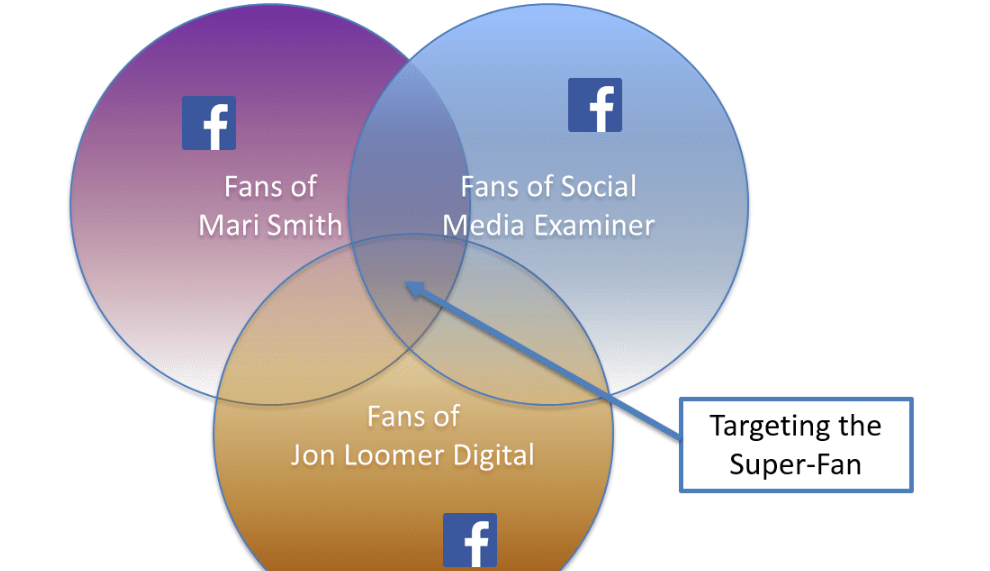
A detailed target audience refers to a specific group of people defined by clear characteristics such as demographics, interests, and behaviors. When advertisers rely on Detailed targeting, they are not just selecting a broad audience, but carefully narrowing down users who are more likely to be interested in a product or service. This approach helps advertisers avoid generic messaging and instead focus on users whose profiles closely match the ideal customer.
Building a detailed target audience requires understanding who the customer is, how they behave online, and what influences their decisions. This includes factors such as age, gender, job role, relationship status, purchasing habits, and digital activity. The more accurately this audience is defined, the higher the chances that ads will resonate, generate engagement, and lead to meaningful conversions.
This concept is strongly connected to search terms like buyer persona, audience segmentation, interest-based audiences, behavioral data, and Facebook Ads audience strategy. At Nofal Seo, we help brands build detailed target audiences based on real data analysis to ensure ads reach users with the highest intent and potential value.
To define a detailed target audience effectively, focus on:
-
Identifying clear demographic attributes such as age range, gender, and geographic location
-
Understanding user interests based on pages followed, content engaged with, and topics searched
-
Analyzing online behavior such as purchasing activity, device usage, and platform interactions
-
Matching audience characteristics with the brand’s product or service value proposition
-
Continuously refining the audience based on performance data and campaign results
Detailed targeting expanded
Detailed targeting expanded is a feature that allows advertising platforms to go beyond the exact audience settings you define and reach additional users who are likely to respond to your ads. When using Detailed targeting, enabling expansion gives the algorithm more flexibility to show ads to people with similar behaviors or interests, even if they don’t exactly match every targeting filter you selected. This option is designed to improve reach and performance when the system predicts better results outside the narrow audience scope.
The main idea behind expanded targeting is performance optimization. Instead of limiting delivery to a very strict audience, the platform uses machine learning to test nearby audience segments that may convert at a lower cost. This can be especially useful for campaigns focused on conversions, leads, or sales, where the goal is results rather than strict audience control.
This feature is commonly associated with concepts like machine learning optimization, audience expansion, conversion-focused campaigns, Facebook Ads delivery system, and performance-based targeting. At Nofal Seo, we analyze campaign goals and data signals to decide when expanded targeting should be used to scale results without losing audience relevance.
To understand when detailed targeting expansion is useful, consider these points:
-
It helps increase reach when your defined audience is too small
-
It allows the platform to find users with similar intent and behavior
-
It can lower cost per result by testing new audience segments
-
It works best with conversion-optimized campaigns
-
It requires continuous monitoring to avoid irrelevant traffic
Advantage detailed targeting
Detailed targeting gives advertisers a strong advantage by allowing them to control who sees their ads with a high level of precision. By using Detailed targeting, marketers can focus their budget on users who are more likely to be interested, engaged, and ready to take action, instead of wasting spend on broad or irrelevant audiences. This precision makes campaigns more efficient and improves overall advertising performance.
The main advantage of detailed targeting lies in relevance. When ads are shown to people whose interests, behaviors, and demographics match the offer, the message feels more personal and timely. This leads to higher engagement rates, better click-through rates, and stronger conversion outcomes compared to generic targeting approaches.
This advantage is closely tied to keywords such as ad relevance score, audience precision, conversion rate optimization, cost-effective advertising, and Facebook Ads performance. At Nofal Seo, we leverage Detailed targeting to help businesses maximize ROI, reduce wasted ad spend, and achieve sustainable growth through data-driven audience strategies.
Key advantages of using detailed targeting include:
-
Reaching users who are genuinely interested in the product or service
-
Improving ad relevance and user experience
-
Reducing cost per click and cost per conversion
-
Increasing engagement and conversion rates
-
Allowing better control over campaign performance and scalability
Detailed targeting expansion on or off
Choosing whether to turn targeting expansion on or off depends largely on campaign goals and audience size. When advertisers use Detailed targeting, enabling expansion allows the platform to reach users outside the exact targeting settings if it predicts better performance. Turning it off, on the other hand, keeps delivery strictly limited to the defined audience, giving advertisers more control over who sees the ads.
There is no single correct option for all campaigns. Expansion works well for performance-driven campaigns where the goal is conversions, leads, or sales, while keeping it off is often better for brand-sensitive campaigns that require strict audience definitions. The decision should always be based on testing, data analysis, and ongoing optimization rather than assumptions.
This choice is commonly discussed alongside topics such as Facebook Ads optimization, campaign testing, audience control, conversion-focused strategies, and ad delivery algorithms. At Nofal Seo, we help brands decide when to enable or disable targeting expansion based on real performance data to ensure the best possible results.
How to decide whether to turn expansion on or off:
-
Turn it on when your audience is small and results are limited
-
Turn it on for conversion or lead campaigns focused on performance
-
Turn it off when audience relevance is critical
-
Turn it off for niche or brand-sensitive campaigns
-
Always test both options and optimize based on results
How is detailed targeting determined on Facebook?
1- “Detailed Targeting” in the “Include People who match” field.
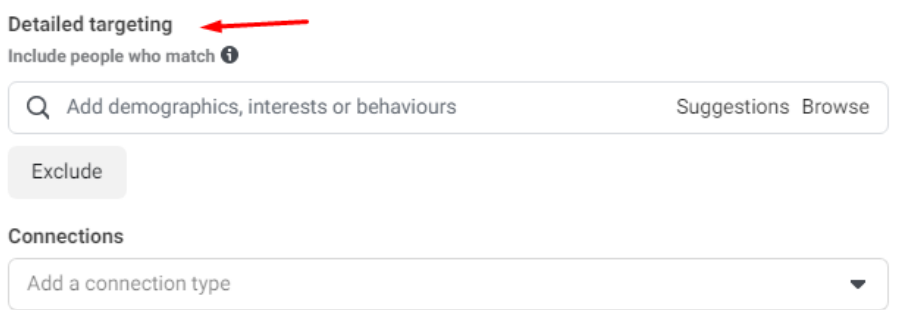
2- In the box we find three options:
“Add demographics, interests or behaviors” means entering a choice from these three options, which are his data, behavior and interests.
3- By clicking on the “Browse” button, three options will appear, as we see below:
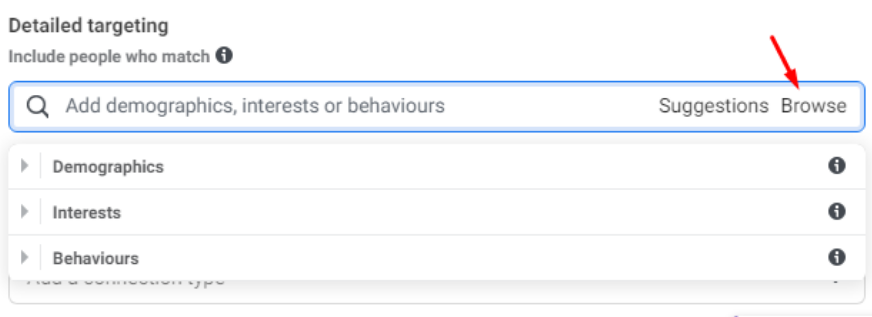
- Choosing “Demographics” to specify the client’s job and education if he is a student, bachelor or doctorate.
- The second option “Interests” means the interests of the customer and we get them from the groups and Facebook pages that have been liked and from the publications that you write and will be through Facebook monitoring of us.
- The third option “Behaviors” means the customer’s behavior on the Internet, is he buying from the Internet or not? What type of browser are you using? Before going into the details of Detailed targeting on Facebook, we first want to know, how is that information that was mentioned about the customer determined? It is known through your account from the information that you put in. All of this data is recorded in demographic data. But it is data that is not highly reliable because some people put fake (incorrect) information.
- Now you can click on the arrow next to the selection “Demographics” and a sub-menu will appear.
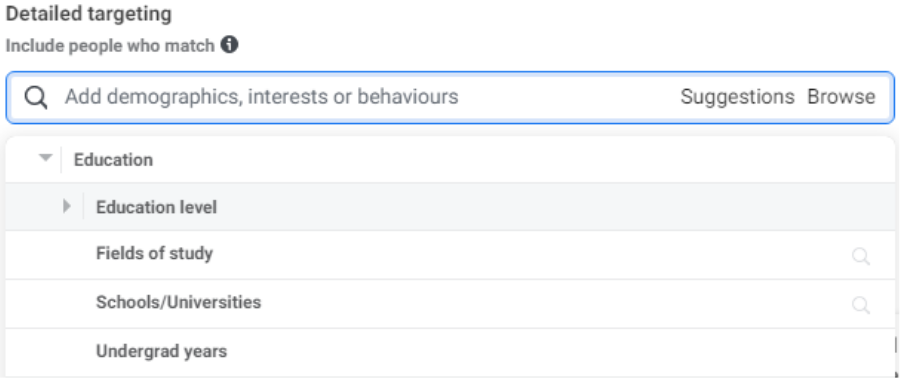
- When you click on the arrow next to “Education”, for example, you will see sub-menus specifying the level of his education, as shown below:
- Note when you look at any of these items, the details of the item appear on the right as we can see:
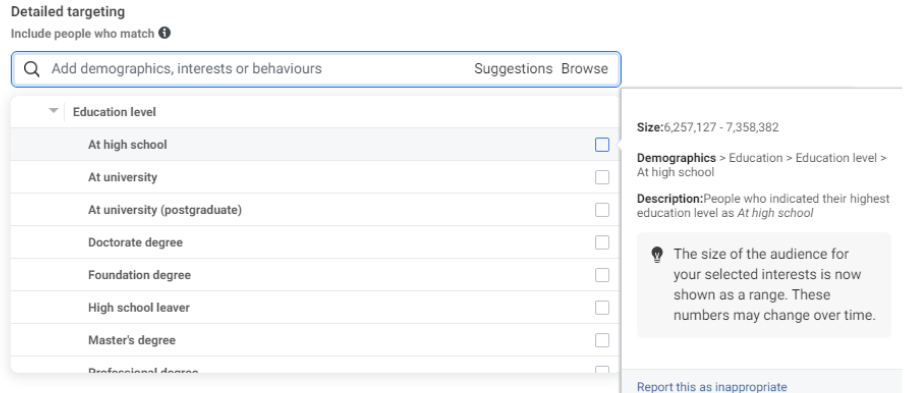
- When we click on the item we want, another box appears, in which we can write what we want.
- From the “School” item, when you click on it, a box appears in which we write the name of the school (when writing the initials, an index of similar words appears for us).
- From the “Undergrad Years” item, two numbers will appear for you, from which we specify the beginning of the study and the end of it.
- Item “Life Events”There are many items in this item. From the “Birthday” sub-menu, a menu appears, and when you press the arrow next to the item “Birthday Month,” a sub-menu appears that specifies the month of birth.
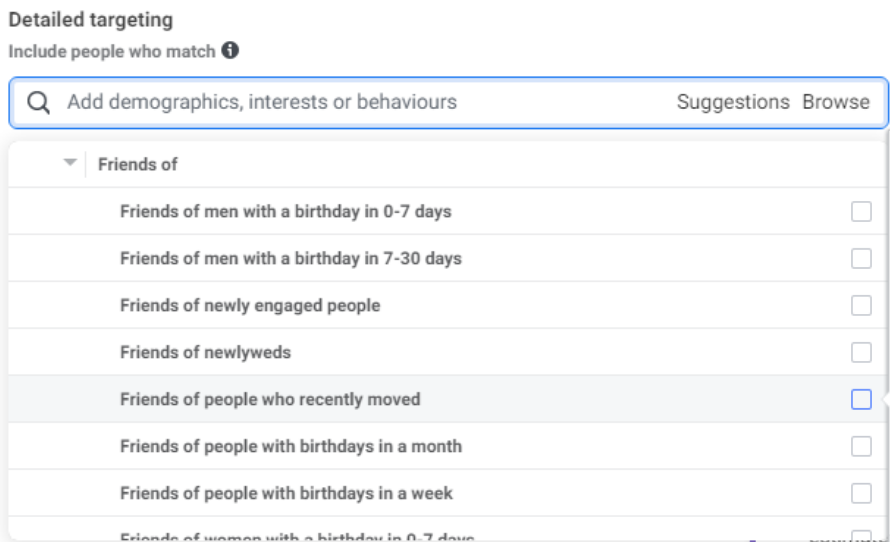
- Clause “Friend of” This clause applies to birthdays during a certain period, as we see:
- “Long-distance relationship”
- “New Job” are people who work in a new occupation.
- Parents
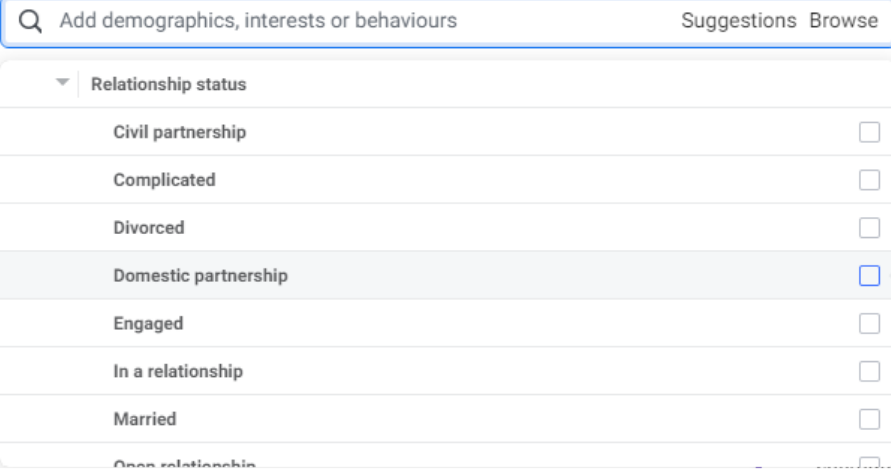
- “Relationship” shows a submenu “Relationship Status” when pressed it shows a detailed menu as we can see:
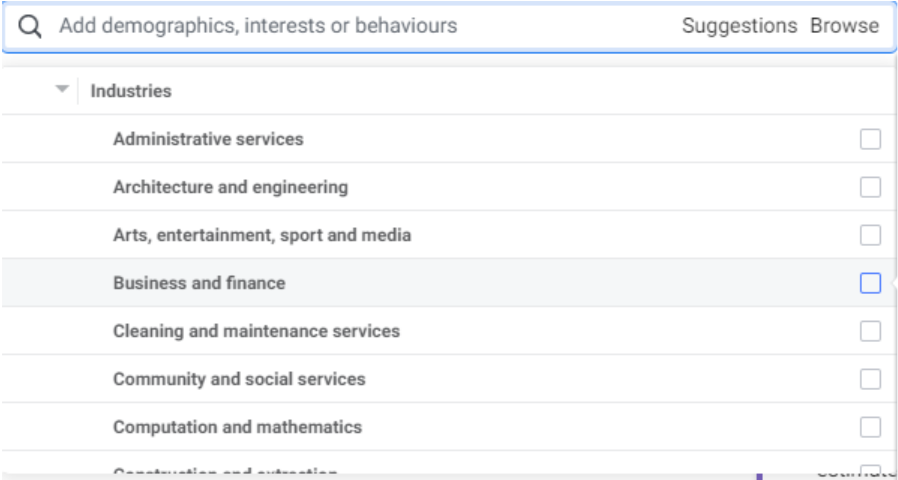
- “Industries” means a specific industry, and when you click on the adjacent arrow, a detailed list appears, as we can see:
- “Interests” (this “category” is very large) when pressed, a submenu appears, as we can see below:
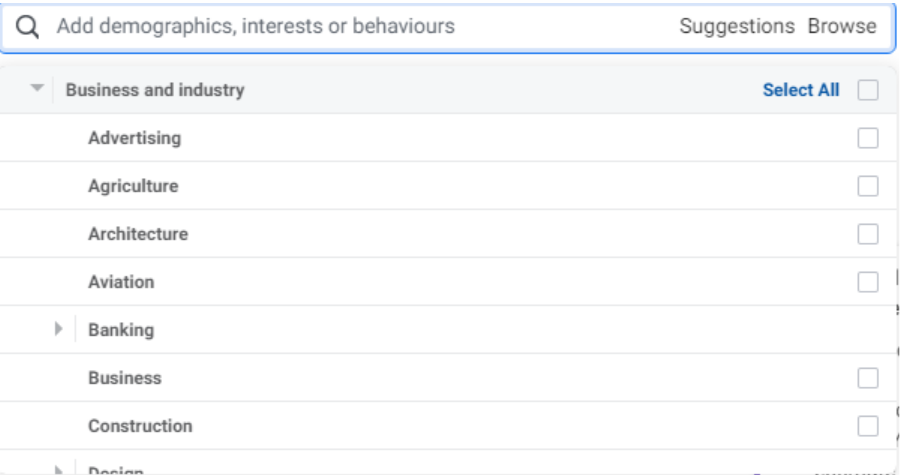
Note: In Detailed targeting on Facebook, the more layers are made, the less accurate the targeting will be.
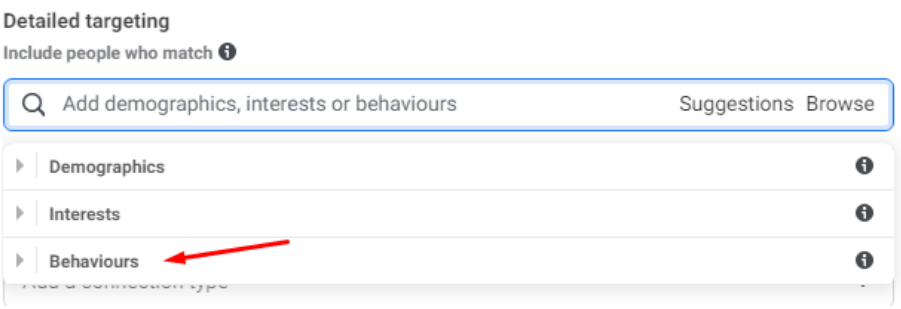
- Clause “Behavior”, including through the actions of customers on Facebook, we target users, and for its work, the “Browse” button is pressed on the page titled “Create a Saved Audience”.
- Three menus appear for you to choose “Behavior” as shown in the following figure:
- Another submenu appears, as we can see:
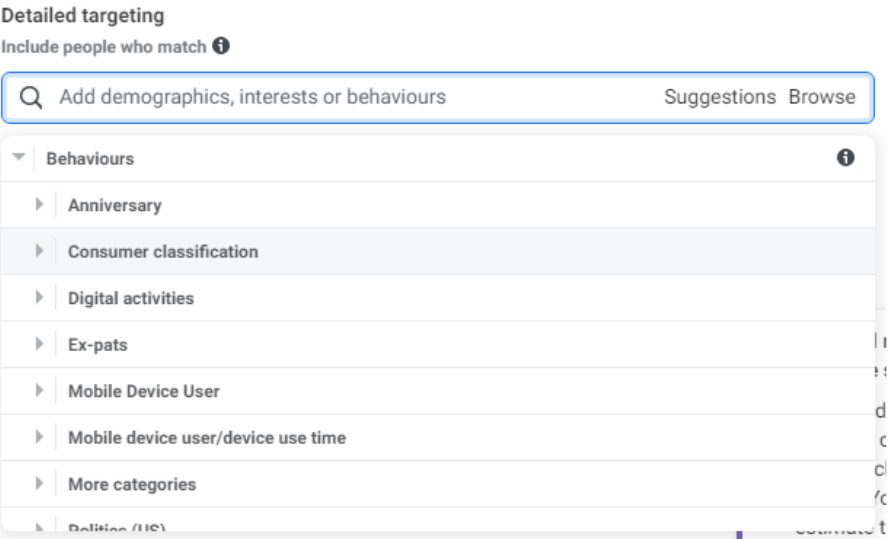
- The item “Anniversary” in the Detailed targeting, when you click on it, the phrase appears:
“Anniversary within 61-90 days” means people who have an anniversary within the next 3 months. These are targeted by checking the checkbox next to them.
Note that there is a list of Detailed targeting similar to the same name “Anniversary” at the bottom of the “Demographics” menu in the “Life Events” sub-menu and the difference between “Demographics” and “Behaviors”.
Behaviors mean that Facebook discovers a user without the user typing it.
Demographics mean that the user writes about himself.
- We open the “Consumer Classification” menu. When pressed, a submenu appears as follows:
- We open the “Digital activities” menu, which means digital activities on Facebook. When you click on it, two menus appear: “Operating System”, when you click on it, a phrase that means targeting individuals who use Windows 10 appears as “Operating system”.
- The “canvas Gaming” menu means people who play games on Facebook. When you click on it, several options appear. You close them and go to the “con-sole gamers” option. This means people who play games in general.
- From the “Digital activities” sub-menu, we find the “Facebook page admins” menu. When you select it, you will find several options, including “Internet Browser Used.” When you click on it, 6 options appear below it
- The “Operating System Used” menu, when pressed, shows main and sub-options, as shown below:
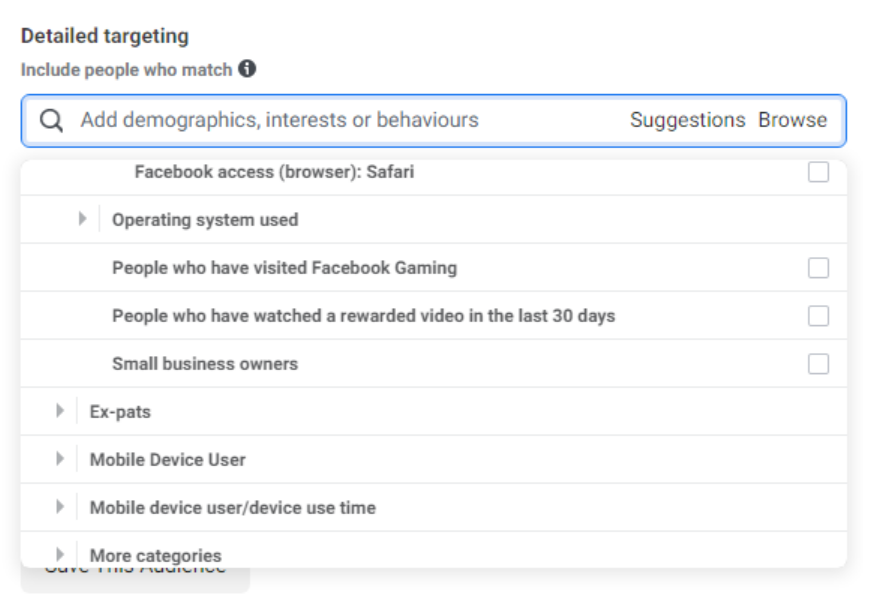
- The first “Facebook Gaming” means a platform created by Facebook for people who visit the “Games developer” who enter this platform.
- The second “Rewarded video” means rewarded videos for people who play Games.
- The third “Small business owners” means people who started a small business and can be targeted.
- The fourth “Technology early adopters” are those who are always racing to use new technology.
- Close the menu and open “Expats”, which means expatriates. When you click on it, several options appear, as we can see:
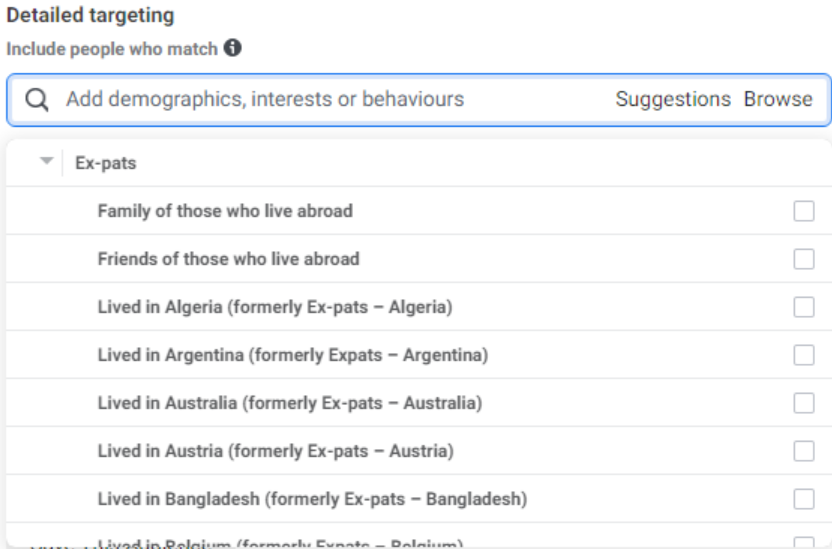
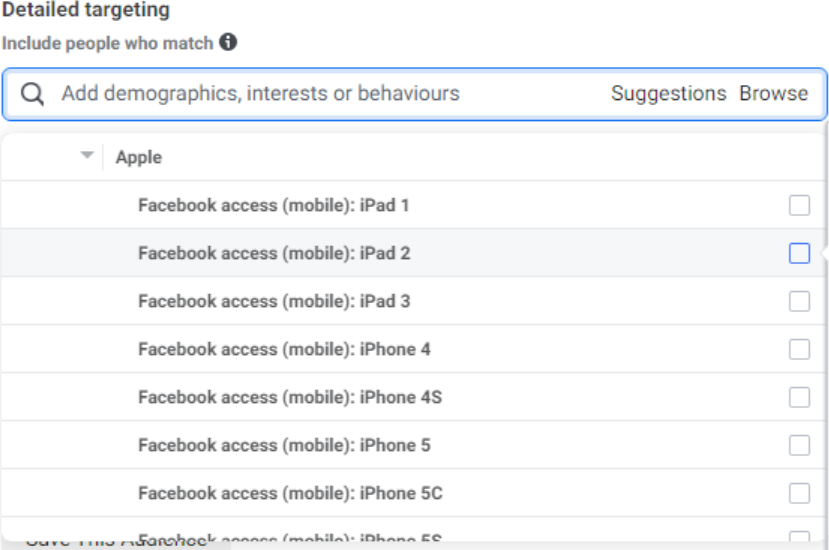
- The “Mobile Device User” menu means people who use certain devices from the mobile. When you click on it, two menus appear, we choose “All Mobile Devices by Brand.” Three menus and many options appear, including “Apple,” so many options appear, as we see below:
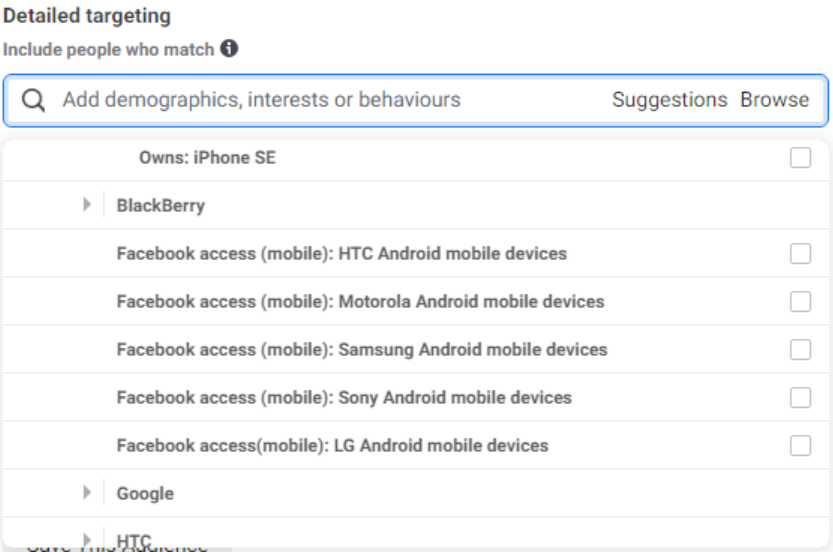
- From the “BlackBerry” menu, when you press it, several options appear, other than “Apple” types, as we can see below:
- From the “Mobile Device User/Device Use Time” menu, when you click on it, several options appear that contain the periods during which people have purchased mobile devices.
- “More Categories” when you click on it, several options appear, as shown below:

- “Politics” means political processes in the United States of America. When selected, three options appear related to politics.
- “Purchase behavior” means purchasing behavior, and when selected, “Engaged shoppers” appears, which means people who buy a lot as a result of a Facebook ad, and you can find out when people click on the “Shop now” button.
Note: Facebook has a pixel inside the site, so it is known who made the purchase.
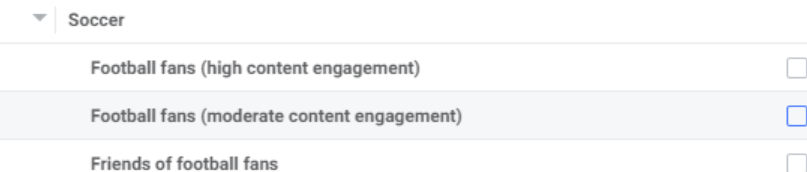
- From the “Soccer” menu, meaning people interested in football, when you click on it, a sub-menu appears, as we can see below:
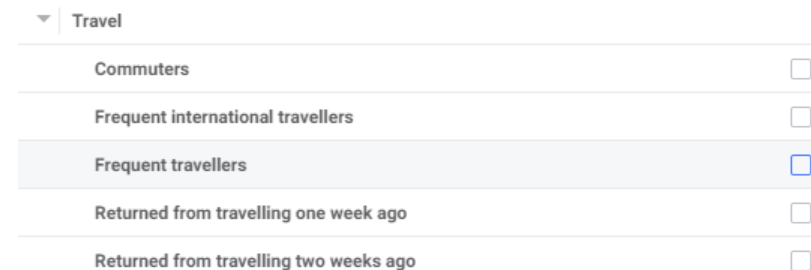
- The “Travel” menu, when pressed, shows several options, as shown below:
Select the type of connection
- After creating the desired audience, we find at the end of the page the “Connection” item. When you press the arrow next to “Add a connection type,” a list appears divided into three parts, as shown below:
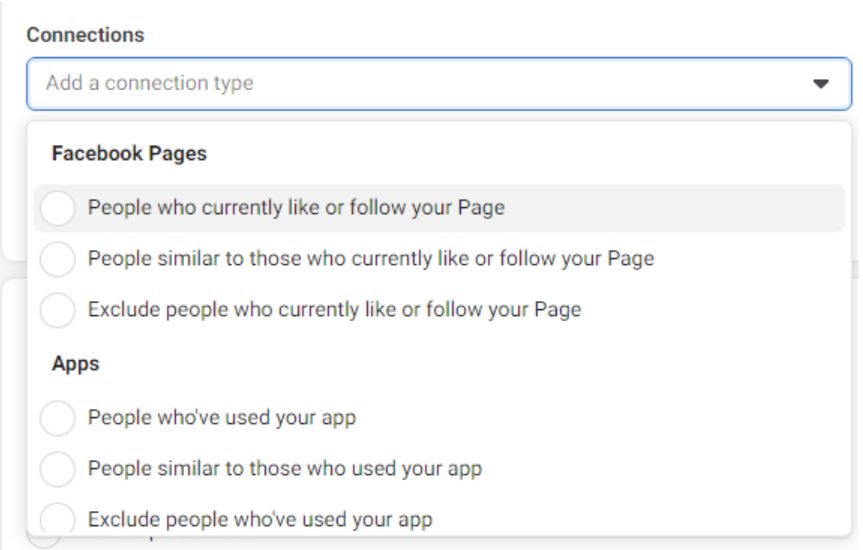
- The first section “Facebook Pages”
1- The first choice from this section means Do people want people to like your pages? When you choose this option, a page appears asking for the name of the page where the fans are, so we write the name of the page in the designated field.
2- The second in the first section means people who are similar to the people we have on the page and vice versa.
3- The third option means excluding the people we have.
- The second section “Apps”
1- The first choice in this section means people who use one of our applications and we write the link for the application.
2- The second choice means the people who are similar to users of an application.
3- The third means excluding people who use this application.
- Section Three “Events”
1- The first choice in it means the people who interacted with the page.
2- The second choice means excluding them.
After selecting the two options, one for the audience and the other for excluding these audiences, we see at the top of the page that the two options have been added, including “Custom Audiences.” After that, we confirm the process of creating the audience by pressing the “Create Saved Audience” button, so the audience is saved with the specifications we mentioned. Then a new page appears titled “Audience” showing the audience name, gender and other data. When you click on the “Refresh” button at the top left of the page, a page will appear with other additions. And you can modify the audience in the Detailed targeting you created as you like. Now we are done and we will explain to you in the following article on the places where the advertisement appears on Facebook and how to take into account the form of the advertisement in the places where it is displayed.
Do you need a consultation about this topic?
Contact on WhatsApp
