
Message ads on Facebook
Book a Free Consultation Now
Would you like to know more about this topic?
Contact us on WhatsApp and get a free consultation from our experts
Contact on WhatsApp NowWhat is a message ad?
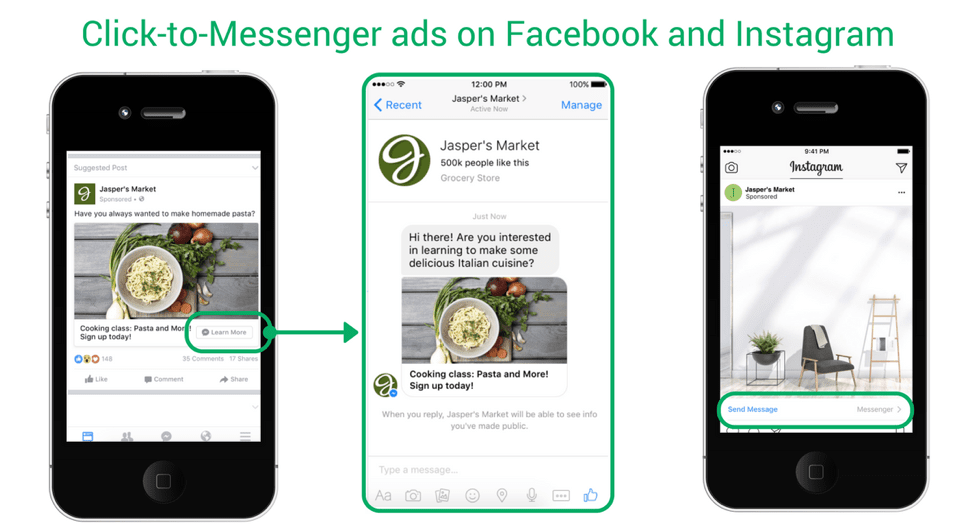
A message ad is an advertising format designed to start a direct conversation between a business and potential customers inside messaging platforms such as Facebook Messenger, Instagram Direct, or WhatsApp. Instead of sending users to a website or landing page, this type of ad encourages instant interaction, making it ideal for businesses that rely on inquiries, consultations, bookings, or personalized communication. When advertisers use Message ads, they focus on lowering friction and guiding users straight into a chat where questions can be answered and trust can be built in real time.
Message ads are particularly effective for lead generation and customer support because they create a more human and responsive experience. Rather than waiting for users to fill out forms or browse multiple pages, businesses can engage prospects immediately and move them through the decision-making process faster. This format works well across multiple industries, especially services, local businesses, and high-consideration products that require explanation before purchase.
Key characteristics of message ads include:
-
Message ads open a direct chat instead of redirecting users to external pages.
-
They reduce the time between user interest and business response.
-
Conversations allow for personalized replies based on customer intent.
-
Messaging creates a higher sense of trust compared to static ads.
-
Message ads support automation through instant replies and chat flows.
-
They are optimized for users who prefer private communication over browsing.
How to run message ads on Facebook?
Running message ads on Facebook involves setting up campaigns that encourage users to start a conversation directly from the ad. The process begins with choosing the correct campaign objective and configuring messaging destinations such as Messenger or Instagram Direct. This setup allows advertisers to guide users seamlessly from ad interaction to conversation. When businesses run Message ads, they prioritize engagement and responsiveness over traditional click-based actions.
The setup process relies on Facebook Ads Manager, Messages campaign objective, Messenger destination, click-to-message ads, and automated chat setup, all of which help streamline conversations at scale. Proper configuration ensures that messages are delivered to the right inbox, responses are timely, and conversations are structured to qualify leads effectively.
Steps to run message ads on Facebook include:
-
Open Facebook Ads Manager and create a new campaign.
-
Select the Messages objective to focus on conversations.
-
Choose the messaging destination (Messenger, Instagram, or WhatsApp).
-
Define your audience based on demographics, interests, or custom data.
-
Set budget and schedule according to your campaign goals.
-
Design ad creatives with clear call-to-action prompts like “Send Message.”
-
Configure automated greetings or instant replies to guide conversations.
-
Launch the campaign and monitor message volume and response quality.
What is the difference between message ads and conversation ads?
The difference between message ads and conversation ads lies mainly in how the interaction with the user begins and how much control the advertiser has over the conversation flow. Message ads are designed to initiate a direct chat when a user clicks on the ad, allowing the business to respond manually or with basic automation. This format focuses on encouraging users to start a conversation quickly and naturally. When advertisers use Message ads, the primary goal is to open a messaging thread and engage users through real-time or semi-automated replies.
Conversation ads, on the other hand, are built around predefined conversation paths and structured interactions. Instead of starting with an open-ended chat, conversation ads guide users through specific options, buttons, or flows that qualify intent before a human interaction begins. These ads are more controlled and are often used for lead qualification, FAQs, or routing users to the right solution without requiring immediate manual responses.
Message ads are commonly associated with click-to-message campaigns, direct messaging ads, manual customer conversations, and personalized chat interactions, while conversation ads rely on structured chat flows, automated messaging, predefined reply buttons, lead qualification funnels, and chatbot-driven experiences. Each format serves a different purpose depending on whether the business prioritizes human interaction or scalable automation.
Key differences between message ads and conversation ads include:
-
Message ads open a direct chat with minimal structure, allowing free-form conversations.
-
Conversation ads guide users through predefined options and automated flows.
-
Message ads rely more on manual or semi-automated responses.
-
Conversation ads are optimized for scalability and lead qualification.
-
Message ads feel more personal and conversational.
-
Conversation ads focus on efficiency, filtering, and intent segmentation.
How do message ads work?
- In order to create message ads, first from the campaigns page, click on “Create”.
- Then choose Message Ads or “Messages”
- After that we name the campaign, for example (messages).
- Then go to the “AD Set” page, we will find two types of ads:
- “Click to message”: These are advertisements in which the “Call To Action” button is a message
- “Sponsored message”: These are ads that go directly to the customer’s chat, but note that this type of ads is directed to people who have already contacted you before, as we see:
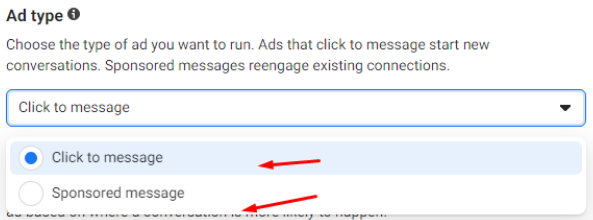
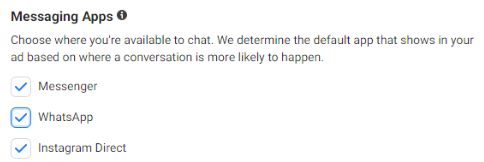
- We choose the type of “Click to message”, it will start asking you if the person needs to communicate with you via
- Messenger.
- WhatsApp.
- Instagram Direct.
- We choose the three options, and it is he who determines the best for the communication process on any application, as we can see:
- Note that WhatsApp must be WhatsApp Business and be linked to the page on which the advertisement is running.
- After that we select the page we want to place the advertisement on.
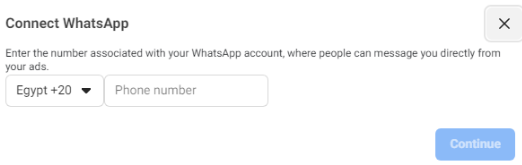
- Then we connect the WhatsApp and Instagram account to it, in case they are already connected, the account will appear to you. I am in the case that they are not connected, select the account you want on WhatsApp or Instagram, as we see:
- Then we set the budget.
- Then we define the audience whether a new audience will be created or an audience from your saved.
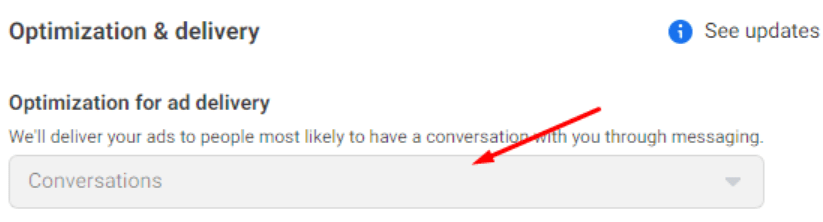
- Go to the bottom of the page at the “Optimization”, we find that it is locked to “conversation”, because you have chosen the three applications, which are Messenger, WhatsApp and Instagram, and this means that it will start improving advertising and directing it to people who communicate through messages as we see:
But in the event that you have chosen one application, and you want to send messages to it, not the Messenger, you will find that the “Optimization” differs as we see:
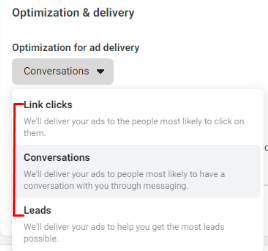
Several choices
- “Link Clicks”: represents the customer who clicks on the link in the ad text.
Conversations: Customers who actually communicate and send messages.
“Leads”: This option represents potential customers who previously communicated with messages on other pages and became potential customers. - Each of the three options has an advantage, but it is natural that the optimal choice is “Conversations”, but choosing “Link Clicks” is the best choice because through it you will have an opportunity to reduce the price of the message. Because by choosing the “Link Clicks”, you have selected the customers who press the Send a message button.
- It is better that the text does not contain any links, it is just a text and you make the link only on the “Call To Action” button. So when you ask Facebook to direct the ad to the people who make “Link Clicks”, it will direct the ad to the people who click on the “Call To Action” button or send a message.
- The advantage here lies in the accounting method, which in this case is actually “Link Clicks.” Facebook will send messages to people, but you will only be charged when people or customers actually click on the link in the advertisement. Since you will not include any links in the advertisement except the link associated with the “Call To Action” button, which is to send a message. You will only charge those who send a message, and this makes the message price low.
- Back to the “New Ad” page. We find the page that we have chosen to make the advertisement on.
- We choose “Ad setup”, let it be “Create Ad”.
- Then I select the image from “Add Image”, then click on “Next” and then on “Done”.
- We select the “Primary text”.
- Then we write the “Headline”.
- We can also add a description” as we can see:
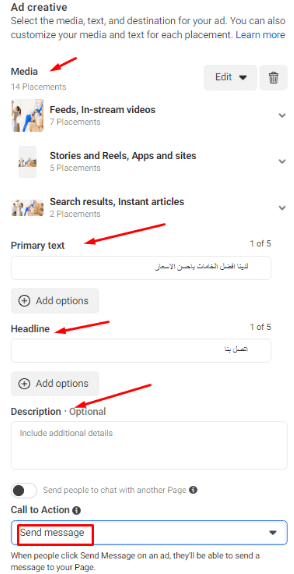
- We notice here in the picture that the “Call To Action” button is specified by sending a message or “Send message”.
You will also find an option called “Send people to chat with another Page”, meaning that if this option is activated, you can make people view the advertisement on this page. But the communication is on another page.
At the bottom there is an option called “Message template” in which we find three options, which are first:
From “Start conversations”, you can write a welcome message by clicking on this option. A screen appears, as we can see:
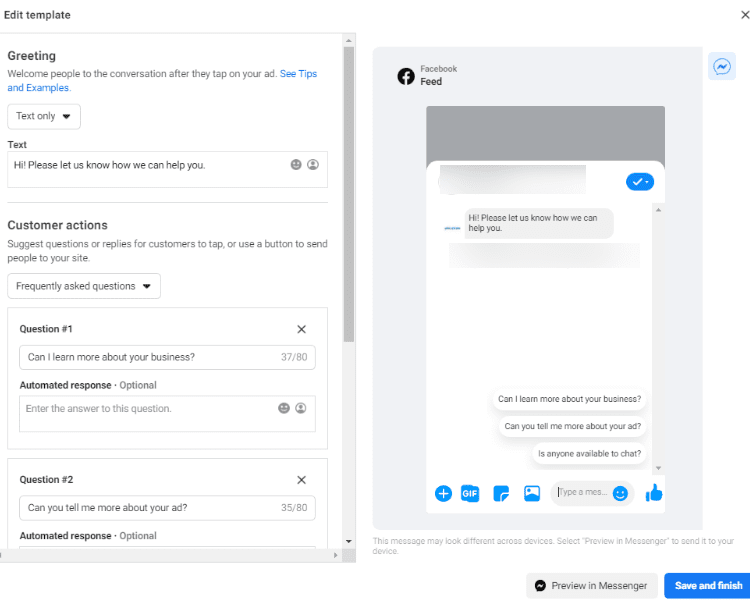
- In it, you specify whether the welcome message you want is text only, text and image, and no text and video.
From the same screen, we can specify the questions that we want to ask the customer, and you can make a quick response or an automatic response, and you can also write the response manually.
You can also name this “template” to use it at any time.
After completing the questions and what you want to appear in the messenger messages, click on “Save and Finish”.
When we return to the advertisement page, we will find that the “template” that we have set is saved with - We can use the “template” that we have made, create a new one, modify it, or copy it.
You can also make a preview of this “template”, a message will be sent with the preview on the page you selected before and it will appear to you - After completion, we publish and when the advertisement is approved and run, the audience will start interacting by sending messages and ready responses begin to appear, or you respond manually as we explained before. This way you have message ads on Facebook.
Do you need a consultation about this topic?
Contact on WhatsApp
