
How to Find LSI Keywords to Improve Your Rankings

Book a Free Consultation Now
Would you like to know more about this topic?
Contact us on WhatsApp and get a free consultation from our experts
Contact on WhatsApp NowIf you want to rank higher on Google, understanding how to find LSI keywords is one of the simplest ways to make your content more complete and relevant. LSI keywords are words and phrases that are semantically related to your main keyword, and adding them naturally helps search engines understand what a page is really about. This works hand in hand with broader choices around how you research and write your keywords in the first place. In this guide, we cover what LSI keywords are, how Google actually treats them, where to find them for free, and how to add them without falling into the keyword-stuffing trap. If you would rather leave this to specialists, Nofal SEO’s on-page optimization service handles semantic keyword research and placement for you.
How Do Search Engines Understand a Page’s Content?
Before getting into LSI keywords specifically, it helps to understand how search engines process a page in the first place. Google crawls every page on a site, tries to understand its topic, and then indexes it under the categories and queries it is most relevant to. This is where semantically related terms come in: they give Google extra context about what a page covers, beyond just the exact keyword being targeted.
Modern search engines do not simply count how many times a keyword appears. Instead, they evaluate pages using natural language processing to judge whether a page thoroughly and accurately answers a query. Google explains this in detail in its own documentation on how Search actually works. This is also closely tied to good general on-page SEO practice, not just keyword choice.
What Are LSI Keywords?
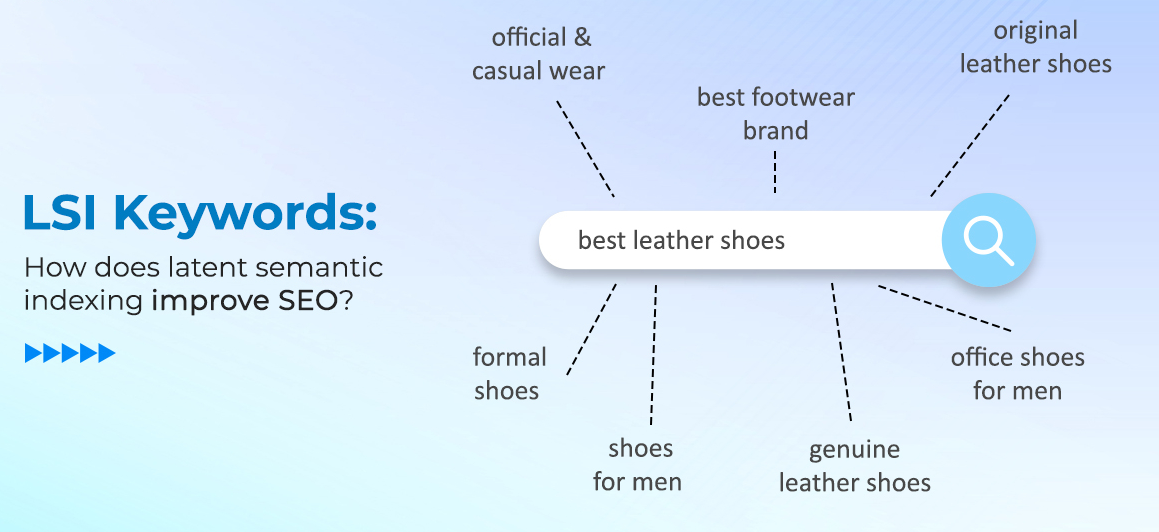
LSI stands for Latent Semantic Indexing, an older information-retrieval technique. In SEO, the term is used loosely to describe words and phrases that are conceptually related to a main keyword. For example, if the main keyword is best leather shoes, related terms might include original leather shoes, best footwear brand, formal shoes, or office shoes for men.
Are LSI Keywords the Same as Synonyms?
Not exactly. Sometimes a related term is a true synonym, but more often it is simply a word or phrase that tends to appear alongside the main keyword because it belongs to the same topic. For the keyword SEO, for instance, related terms could include search engine optimization, organic traffic, or website ranking, none of which are strict synonyms, but all of which add useful context.

Does Google Actually Use LSI in Its Algorithm?
This is where a lot of confusion comes from. Google does not use traditional Latent Semantic Indexing as part of its ranking algorithm. Instead, it relies on advanced natural language processing systems to interpret meaning, intent, and context. In practice, the outcome is similar: pages that cover a topic comprehensively, using related terms and concepts, tend to perform better than pages that repeat a single keyword over and over.
A closely related concept is Google semantic search, which evaluates a page holistically by analyzing relationships between words rather than checking for a predefined list of terms.
Why LSI Keywords Matter for SEO
Using related terms alongside a main keyword offers several practical benefits:
- They help search engines understand the full context of a page.
- They can improve rankings for a wider range of related search terms.
- They reduce the risk of over-optimization and keyword stuffing.
- They add depth and completeness to content.
- They help content match real user search intent more accurately.
Because of this, our approach at Nofal SEO is built around aligning content with genuine search intent at every stage, rather than chasing a single keyword. That tends to lead to better engagement, longer dwell time, and higher conversion rates.
How to Find LSI Keywords
Building a solid list of related keywords does not require expensive tools. Here are the most reliable free methods.
Check Google’s Related Searches and “People Also Ask”
Type the main keyword into Google and scroll to the related searches section at the bottom of the results page. For a keyword like face masks, related searches might cover price, texture, or washability. The People Also Ask box is equally useful for understanding what else an article is expected to cover.
Use Google Autocomplete
Start typing a keyword into the Google search bar and note the phrases it suggests. These are real queries people search for, which makes them excellent candidates for subheadings or supporting points.
Look at the Bolded Terms in Search Snippets
Google often bolds certain words within page snippets that match a search query. A search for sunflower oil, for example, may also highlight sunflower seeds, a sign that the two terms are closely related.
Try Google Images
Searching a keyword in Google Images and reviewing the related terms shown above the results is a quick, often overlooked way to find more related phrases.
Use a Dedicated Keyword Research Tool
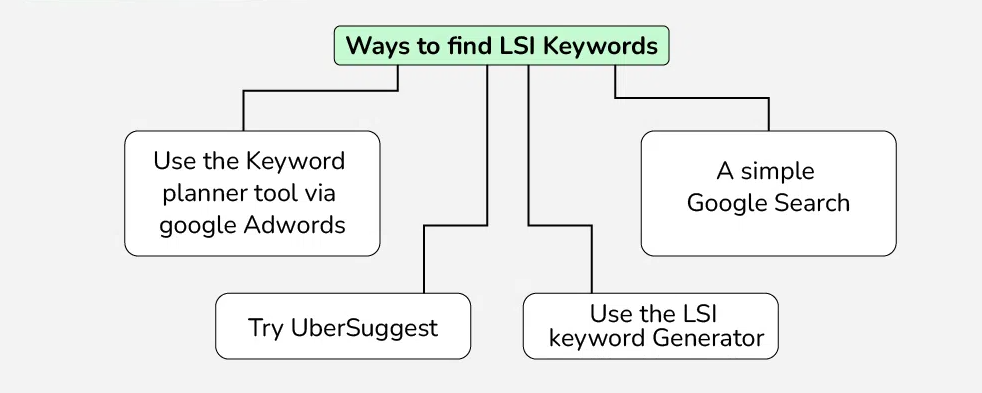
For a longer, more organized list, tools like LSIGraph, Ahrefs, or Google Keyword Planner help uncover related phrases and show how often people search for them. Ahrefs’ guide to keyword research and Moz’s keyword research guide are both solid starting points for going deeper, alongside our own guide to writing effective keywords.

How to Use LSI Keywords in Your Content
Once a list of related terms is ready, the next step is placing them naturally:
- Break long sections into smaller ones and use related terms as subheadings.
- Turn related terms into questions to introduce a new point.
- Add a short definition for a related term when it fits the topic.
For example, if the main keyword is automatic soap dispenser, a related term could be worked in as a statement (the biggest benefit of an automatic soap dispenser is touch-free use), a question (do you need an automatic soap dispenser for your bathroom?), or a subheading (How to Install an Automatic Soap Dispenser). None of these feel forced, and that is the goal.
Where to Place Related Keywords
- Within the main body content, wherever they fit the topic.
- In H2 or H3 subheadings — see our guide on using subheadings properly for more detail.
- In the introduction or conclusion, if relevant.
- In image alt text.
- In the meta description and title, when it makes sense.
Do not force related terms in just to check a box. A commonly cited target for overall keyword density is around 1.5 percent, but there is no strict rule for related terms specifically, add them wherever they read naturally.
Common Mistakes to Avoid When Using LSI Keywords
A few missteps come up often when applying this technique:
- Stuffing related terms into sentences where they do not fit grammatically.
- Repeating the exact same phrase throughout the article instead of varying it naturally.
- Copying a raw list from a keyword tool without checking whether each term actually fits the content.
- Ignoring image alt text and metadata, which are also good places for relevant terms.
- Focusing only on keywords while neglecting overall content quality and structure.
LSI Keyword Examples
A few quick examples help illustrate the idea:
- Main keyword: SEO. Related terms: search engine optimization, website ranking, organic traffic, Google algorithm.
- Main keyword: Web Design. Related terms: responsive design, UX/UI, website layout, mobile-friendly.
- Main keyword: Cold Brew Coffee. Related terms: grind size, cold water, brewing time, coffee filter.
Semantic Terms Worth Targeting Alongside LSI Keywords
Beyond the specific related terms for a given topic, it helps to keep a broader set of semantic SEO concepts in mind while writing and optimizing: semantic search, natural language processing, search intent, topical relevance, topic clusters, entity SEO, co-occurring keywords, content depth, E-E-A-T and trust signals, on-page SEO, internal linking, and ranking factors tied to Google updates like Hummingbird, RankBrain, and BERT. Weaving a few of these into the planning process, rather than just the keyword list, tends to produce content that holds up better over time.
Do LSI Keywords Still Matter in the Age of AI Search?
Search has moved further toward AI-generated overviews and conversational answers, but the underlying principle behind LSI keywords has not gone away. Systems that summarize or rank content still reward pages that cover a topic in genuine depth, using the vocabulary real users and related sources actually use. In other words, thinking in terms of related concepts rather than a single exact-match keyword is arguably more useful now than when the term LSI first became popular in SEO circles.
Frequently Asked Questions About LSI Keywords
How many LSI keywords should I use in one article?
There is no fixed number. A typical article naturally fits anywhere from five to fifteen related terms once a topic is covered properly, spread across headings, body text, and image alt text.
Can I use an LSI keyword tool instead of manual research?
Tools like LSIGraph or Ahrefs speed up the process, but it is still worth manually checking Google’s related searches and the People Also Ask box, since real search data often surfaces terms a tool might miss.
Do LSI keywords affect keyword density?
They can reduce the pressure to repeat a main keyword, since related terms carry some of the topical weight instead. This tends to make writing read more naturally while still signaling relevance to search engines.
Where can I get help implementing this on my own site?
If you would rather have this handled for you, book a free consultation with Nofal SEO and we can review your content and keyword strategy together.
Key Takeaways
Learning how to find LSI keywords is not about gaming an algorithm, it is about writing content that genuinely covers a topic well. Find related terms through Google’s own search results and a few keyword tools, place them where they read naturally, and avoid stuffing them in for the sake of it. If a team should handle this research and implementation instead, Nofal SEO’s on-page optimization service is built exactly for that.
Do you need a consultation about this topic?
Contact on WhatsApp
